
The F.L.O.W. Mastery Model
Fluxogenics provides the theoretical framework underlying the concept of effortless performance.
The F.L.O.W. Mastery Model represents its practical application: a structured system in which these principles are organized into a coherent process that can be applied across different contexts to improve performance.
Rather than forcing results, the model focuses on understanding and aligning the conditions under which performance naturally emerges.
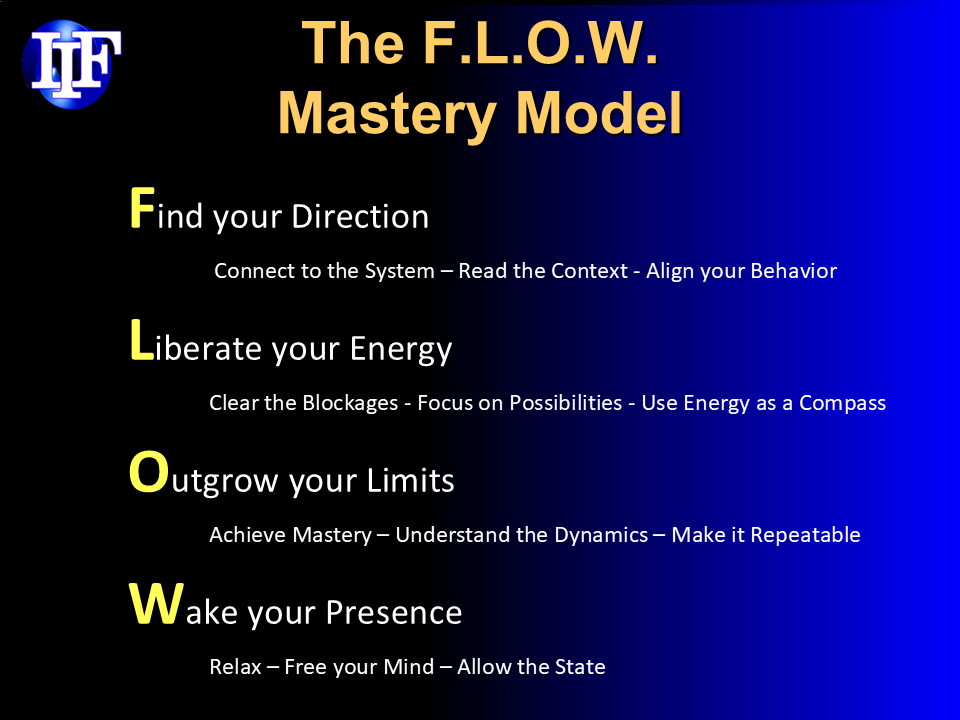
The model consists of four main components:
Find your Direction
Liberate your Energy
Outgrow your Limits
Wake your Presence
Each of these points is divided into three sub-elements, each of which is designed to help achieve the best possible result with minimal effort.
Find your Direction: How to define what truly matters
- Connect to the system: Understand the structure you are operating in
- Read the Context: Identify relevant signals and constraints
- Align Your Behavior: Adjust your actions to what the situation requires
Liberate your Energy: How to make it available and usable
- Clear the Blockages: Remove interferences that reduce effectiveness
- Focus on Possibilities: Direct attention toward actionable options
- Using energy as a Compass: Use feedback to guide decisions and priorities
Outgrow your Limits: How to build functional mastery
- Achieve Mastery: Develop the skills that actually matter
- Understanding the Dynamics: Recognize patterns that govern performance
- Make it Repeatable: Stabilize performance through consistency
Wake your Presence: How to allow performance to emerge
- Relax: Reduce unnecessary tension
- Free your Mind: Eliminate cognitive noise and overcontrol
- Allow the State: Let performance unfold without interference
The model can be examined at a general level and applied to any system — a sports team, a company, an orchestra, or even a mechanical structure — with the understanding that practical details will vary, while the underlying principles remain the same.
Once the model is understood, it can be applied to the different dimensions of the human being — physical, mental, social, financial, and what we may define as the broader dimension of meaning — each considered as a system in its own right. When these dimensions reach a sufficient level of organization, they can in turn be aligned and treated as a single integrated system.
The human system is inherently complex, and improvement has no clear endpoint. For this reason, the process is not something that is “completed,” but something that can be revisited whenever higher performance is required, a phase of stagnation is encountered, or further development becomes necessary.


